The 24 Seasons
of Japan’s Lunisolar Calendar
The 24 seasons are a calendar system. They were developed in ancient China and were later adopted by the Japanese. This calendar uses the sun's position and the moon's cycles to measure time (also known as a lunisolar calendar). Within the yearly cycle, the months are divided into smaller units of time. While you can have months of your regular 28 to 31 day duration, you can also have smaller increments of time, smaller seasons. Known as “sekki” in Japanese, these are two-week increments that traditionally helped guide the ebb and flow of the seasons, their rites, and passages. Their names are inspired by celestial phenomena or what might be growing, arriving, or coming into being. With poetic names like “Frost Descends” or “Wintering Insects Awake,” they were a reminder of the present moment of the year.
Perhaps better known are Japan’s 72 microseasons, which break down these two weeks into smaller units of approximately five days each. Known as pentads, the microseasons really encourage you to take a close look at what is happening day by day!
We find that despite the allure of the microscopic seasons, it’s really these “miniature” two-week seasons to be more manageable. We can remember and find a place for these seasons in our lives. Much can be planned and thought through in two-week increments, and we believe that living life season by season helps bring a sense of progression, renewal, and flow.
Why Live Life through the 24 Seasons?
By being more attuned to the passage of time, we become more grounded, slow down, and feel more connected to the natural world. As we go through our busy day-to-day lives full of screens and meetings, it is easy to forget that small changes are happening every day, and that small adventures are unfolding for the other plants and animals that call this planet home. The 24 seasons help us to acknowledge the subtle change we feel. Kit and I view the 24 seasons of the year as a framework to guide you. It is not a blank canvas, but branches of a tree that all form into a part of the whole.
Making the 24 Seasons Your Own
It may be enough simply to notice the passage of time through these smaller seasons, but how can you feel like an active part of the natural world? Kit and I have found this through the use of seasonal words, or kigo. This is a concept in Japanese haiku, where a specific word or phrase evokes a particular season. Seasonal words can include peepers in early spring, the last hanging persimmon in winter, cats in love, or geese across an autumn sky. As you go through life, look for your own seasonal words. And, if you make a habit of noticing these seasonal elements, you will also begin to notice when they come and go. The seasonal words are the leaves on the branches.
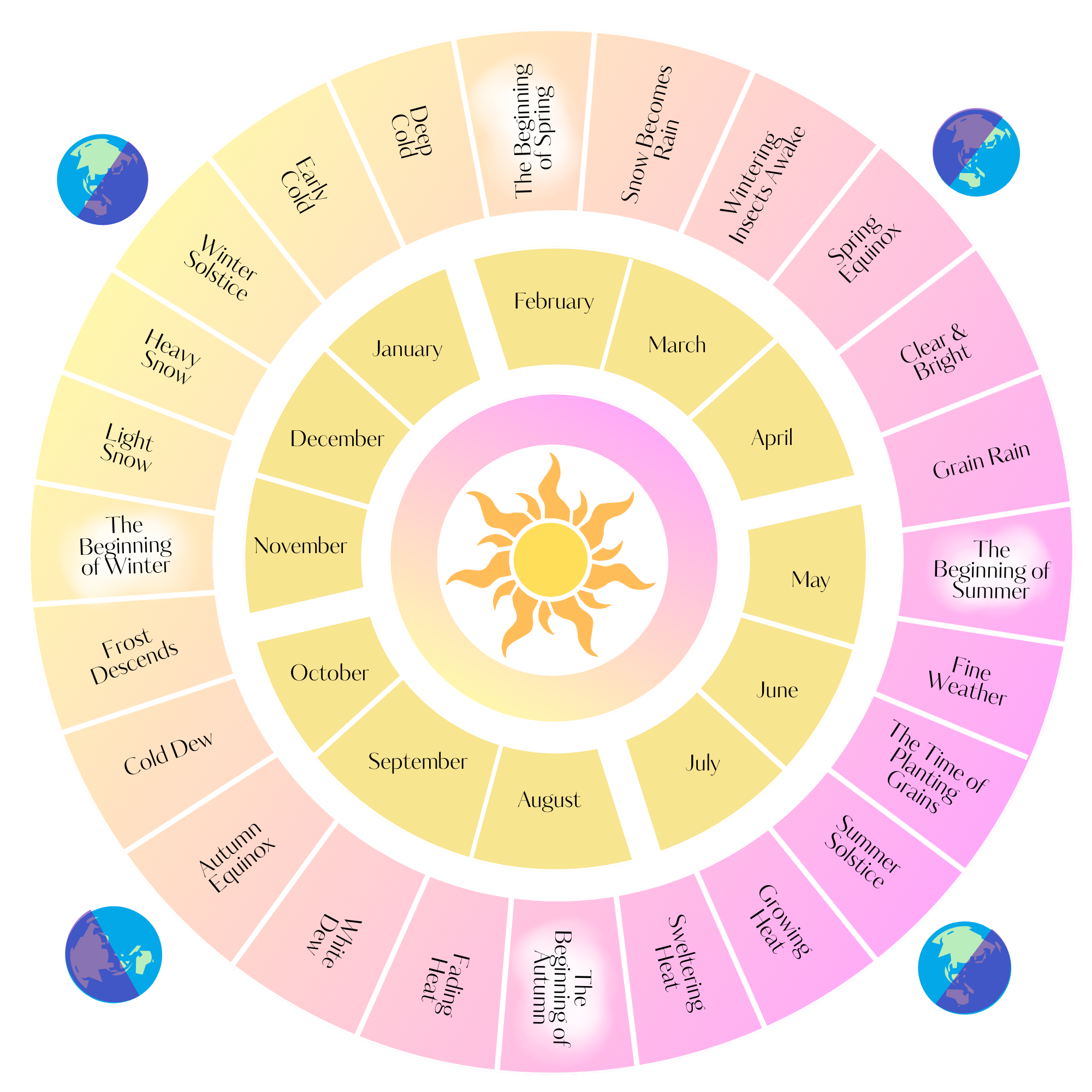
The 24 Seasons of the Year
Notice that spring and the new year begin in early February.
The 24 Seasons and their Dates*
Spring | 春 Haru
Beginning of Spring | 立春 Risshun (February 4–18)
Snow Becomes Rain | 雨水 Usui (February 19–March 4)
Wintering Insects Awake | 啓蟄 Keichitsu (March 5–19)
Spring Equinox | 春分 Shunbun (March 20–April 4)
Clear and Bright | 清明 Seimei (April 5–19)
Grain Rain | 穀雨 Koku’u (April 20–May 4)
Summer | 夏 Natsu
Beginning of Summer | 立夏 Rikka (May 5–20)
Fine Weather | 小満 Shōman (May 21–June 5)
The Time of Planting Grains | 芒種 Bōshu (June 6–20)
The Summer Solstice | 夏至 Geshi (June 21–July 6)
Growing Heat | 小暑 Shōsho (July 7–22)
Sweltering Heat | 大暑 Taisho (July 23–August 6)
Autumn | 秋 Aki
Beginning of Autumn | 立秋 Risshū (August 7–22)
Fading Heat | 処暑 Shosho (August 23–September 6)
White Dew | 白露 Hakuro (September 7–22)
Autumn Equinox | 秋分 Shūbun (September 23–October 7)
Cold Dew | 寒露 Kanro (October 8–22)
Frost Descends | 霜降 Sōkō (October 23–November 6)
Winter | 冬 Fuyu
The Beginning of Winter | 立冬 Rittō (November 7–21)
Light Snow | 小雪 Shōsetsu (November 22–December 6)
Heavy Snow | 大雪 Taisetsu (December 7–21)
Winter Solstice | 冬至 Tōji (December 22–January 4)
Early Cold | 小寒 Shōkan (January 5–19)
Deep Cold | 大寒 Daikan (January 20–February 3)
*Dates are subject to change slightly each year.